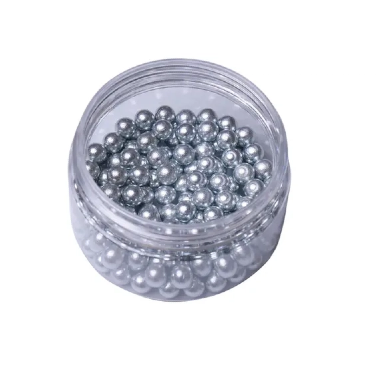
Carbon steel balls are spherical components made from carbon steel, which is primarily iron with varying amounts of carbon. These balls are essential in industrial applications due to their remarkable combination of strength, durability, and affordability. As the preferred choice across industries like automotive, machinery, and consumer goods, carbon steel balls ensure reliable, high performance operation at a competitive cost.
1.What Are Carbon Steel Balls?
Definition and Composition
Carbon steel balls are precision-engineered spherical components made from carbon steel, a widely used metal alloy composed mainly of iron and varying levels of carbon (typically between 0.05% and 1.0%). The carbon content directly influences the ball’s mechanical properties, including strength, hardness, and wear resistance.
Low Carbon Steel Balls
These contain approximately 0.05% to 0.3% carbon. They are softer, more ductile, and easier to shape. Their moderate strength and good malleability make them suitable for low-load applications or those requiring some flexibility, such as in consumer products or light machinery.
High Carbon Steel Balls
With carbon content ranging from 0.6% to 1.0%, these balls are much harder and more wear-resistant. They offer superior load-bearing capacity and durability, ideal for industrial equipment, bearings, and automotive components.
Versatile Use
Due to their balance of performance and cost-effectiveness, carbon steel balls are commonly used across machinery, automotive systems, and various consumer-grade mechanical devices.
2.Types of Carbon Steel Balls
Low Carbon Steel Balls
Low-carbon steel balls contain less than 0.3 % carbon, making them softer and easier to deform or machine. They are ideal for applications where flexibility, shock absorption, and moderate strength suffice.
High Carbon Steel Balls
With carbon content between 0.6 % and 1 %, high-carbon steel balls deliver superior hardness and excellent wear resistance. These balls excel in heavy duty machinery, high load bearings, and applications where long-term durability is critical.
3.Manufacturing Process of Carbon Steel Balls
The production of high quality carbon steel balls involves multiple precise steps to ensure dimensional accuracy and strength:
Wire Drawing: Steel wire is drawn to the required diameter.
Cold Heading: The wire is cut and cold formed into a rough spherical shape.
Flash Removal: Excess material (flash) is removed via rill plates to produce uniformly sized balls .
Heat Treatment: Balls are heat-treated (quenching and tempering) to achieve desired hardness and tensile strength (especially critical for high carbon variants) .
Grinding and Lapping: Precision grinding and lapping yield ultra-smooth surfaces and tight tolerances.
Final Inspection: Rigorous quality checks ensure each ball meets required specifications.
4.Key Properties of Carbon Steel Balls
Hardness
The hardness of carbon steel balls is primarily determined by their carbon content and the heat treatment process they undergo. High-carbon steel balls, in particular, achieve significantly higher Rockwell hardness levels, making them highly resistant to surface wear and deformation. This property is crucial for applications involving repetitive motion or friction, such as ball bearings and precision tools.
Durability
Carbon steel balls are built to withstand substantial mechanical stress, impact, and high-load environments. Their structural integrity makes them ideal for use in demanding industrial and automotive systems, where reliability and long service life are critical.
Corrosion Resistance
While carbon steel does not naturally offer the same corrosion resistance as stainless steel or ceramic materials, its performance can be enhanced with protective coatings like zinc plating, black oxide, or by using lubricants. This ensures acceptable performance in moderately corrosive conditions.
Cost-effectiveness
Compared to stainless steel or ceramic alternatives, carbon steel balls offer exceptional value. Their low production cost and wide availability make them a preferred choice for budget-sensitive projects without compromising performance.
5.Applications of Carbon Steel Balls
Automotive Industry
Carbon steel balls are widely used in the automotive sector, particularly in wheel bearings, steering columns, suspension systems, and transmission assemblies. Their high strength and load-bearing capacity ensure smooth rotational motion and mechanical reliability, even under constant vibration and dynamic forces. They help enhance driving stability, reduce friction, and extend the service life of critical components.
Industrial Machinery
In industrial settings, carbon steel balls are essential for heavy-duty equipment such as pumps, compressors, conveyors, valves, and gearboxes. Their durability and resistance to deformation allow them to perform reliably under extreme pressures and high-speed conditions, improving machinery performance and reducing downtime due to wear.
Consumer Products
You’ll find carbon steel balls in everyday items like bicycles, skateboards, refrigerators, vacuum cleaners, and exercise equipment. They enable smooth rolling, stable motion, and dependable functionality, offering users a quieter and longer-lasting experience.
Construction Equipment
Heavy construction machinery—including cranes, excavators, bulldozers, and loaders—relies on high-carbon steel balls to withstand shock loads, abrasive environments, and harsh outdoor conditions. Their high durability ensures safety and structural reliability in demanding work sites.
6.Advantages of Carbon Steel Balls
High Load Capacity: Suitable for demanding applications with significant mechanical loads.
Versatility: Available in various grades (low/high carbon), sizes, and tolerances to meet diverse needs.
Affordable: Lower unit costs support bulk procurement and cost-sensitive operations.
Sustainable: Carbon steel is recyclable, aligning with sustainable manufacturing practices.
7.Comparison with Other Bearing Ball Materials
Material | Features | Cost Level |
Carbon Steel Balls | High strength, durable, best price-performance | Low |
Stainless Steel Balls | Excellent corrosion resistance for harsh environments | Medium–High |
Ceramic Balls | Ultra-hard, temperature-resistant, low friction | High |
Plastic Balls | Lightweight, corrosion-resistant, but low strength | Medium |
Stainless Steel: Better suited for wet or corrosive environments, but softer and more costly than carbon steel.
Ceramic: Exceptionally high hardness, smoothness, and corrosion resistance, with superior speed and thermal stability—but much higher cost and vulnerability to shock loads .
8.How to Choose the Right Carbon Steel Balls for Your Application
Load Requirements
Start by evaluating the load and impact forces involved in your application. For light to moderate loads, low-carbon steel balls (with lower hardness and more ductility) may be sufficient. However, if the application involves high mechanical stress, heavy radial or axial loads, or constant impact, high-carbon steel balls are recommended due to their superior hardness and wear resistance.
Operating Environment
Consider the working conditions—including exposure to moisture, chemicals, or extreme temperatures. Carbon steel is not inherently corrosion-resistant, so in humid, wet, or chemically aggressive environments, protective coatings like zinc or chrome plating or oil-based lubrication may be essential to prevent rust and degradation.
Speed and Precision Requirements
If your application involves high-speed rotation—such as in electric motors or turbines—you’ll need balls with tighter dimensional tolerances, excellent roundness, and possibly heat-treated high-carbon steel to maintain performance and reduce friction at speed.
Budget and Cost Efficiency
Finally, assess your budget. Carbon steel balls are among the most cost-effective options available, making them ideal for high-volume applications that require a balance of durability and affordability. They offer excellent performance for their price in most industrial uses.
9.Conclusion
Carbon steel balls deliver an unbeatable blend of strength, versatility, and affordability. Whether in automotive, industrial, consumer, or construction applications, they offer reliable performance and long service life with appropriate selection and care. By understanding their types, manufacturing quality, and maintenance needs, you can choose the optimal solution for your specific use cases.


